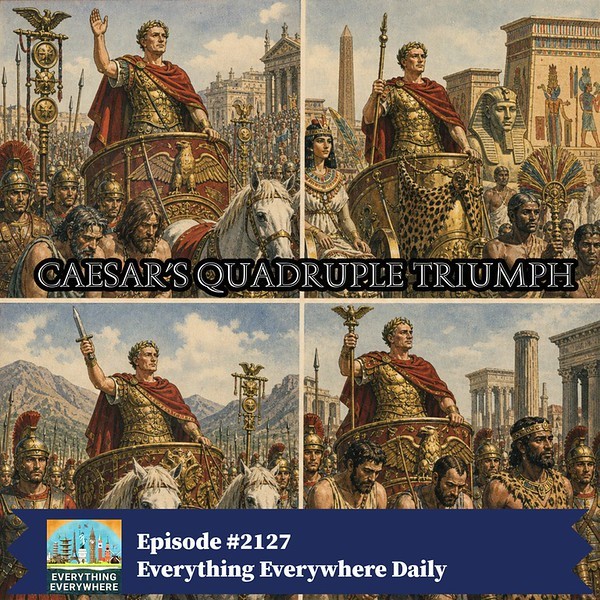
In 46 BC, Julius Caesar returned to Rome after twelve years of absence. He did not come back merely as a general, but as the undisputed master of the Mediterranean world. To mark his homecoming, he orchestrated a spectacle that defied Roman tradition: four consecutive triumphs.
While the common people were dazzled by the wealth and pageantry, the Roman elite saw something far more disturbing. These celebrations were not just a display of military success; they were a political statement that blurred the line between a republican magistrate and a monarch. This event marked the final, glittering stage before the collapse of the Roman Republic.
The Weight of a Triumph
To understand why Caesar’s actions were so provocative, one must understand the significance of a Roman triumph. It was the highest honor a general could receive—a state-sponsored procession where the Senate and people celebrated a victorious commander. For one day, the general was treated like a king, riding in a golden chariot, wearing purple robes, and displaying spoils of war.
However, strict rules governed these events:
* A triumph had to be requested from the Senate.
* It was typically awarded for a single, decisive victory against foreign enemies.
* Victories over fellow Romans in civil wars were generally excluded.
* Multiple triumphs were rare; even legendary figures like Pompey the Great had only three, while others had two or one.
Caesar’s decision to hold four triumphs was unprecedented. It signaled that he viewed his decade of campaigning not as a series of separate events, but as a singular, total conquest of the known world.
The Four Victories
Caesar’s quadruple triumph, likely held over a span of 10 to 14 days between July and September 46 BC, celebrated four distinct campaigns. Each procession highlighted different aspects of his power and raised different questions about his legitimacy.
1. The Conquest of Gaul
The first triumph honored Caesar’s conquest of Gaul (modern-day France) and his defeat of the Gallic leader Vercingetorix. This was the least controversial of the four, as defeating foreign barbarians was the traditional purpose of a triumph.
- The Spectacle: The procession was filled with immense quantities of loot, detailed tableaux of battles, and long lines of captives.
- The Centerpiece: Vercingetorix, held in captivity for years, was paraded through the streets before being executed at the end of the ceremony.
- The Context: Caesar had already popularized this victory through his Commentaries, making the story familiar to the Roman public. It reinforced his image as the defender of Rome against external threats.
2. The Alexandrian War (Egypt)
The second triumph celebrated Caesar’s involvement in the Egyptian civil war, where he supported Cleopatra VII against her brother Ptolemy XIII. This victory was far more contentious.
- The Spectacle: The parade featured exotic imagery evoking the Nile and royal Egyptian splendor.
- The Controversy: The key captive was Arsinoe IV, Cleopatra’s sister and rival. Unlike typical captives, she was spared execution, drawing sympathy from the crowd.
- The Political Problem: Rome had not technically conquered Egypt; Caesar had merely intervened in a dynastic feud to install a friendly monarch. Furthermore, the war was part of a civil conflict against Pompey. By celebrating it as a foreign victory, Caesar was rewriting history to legitimize his civil war actions.
3. The Battle of Zela (Pontus)
The third triumph commemorated the swift defeat of Pharnaces II of Pontus (in modern-day Turkey). This battle is historically significant less for its scale and more for Caesar’s famous dispatch to Rome: “Veni, vidi, vici” (“I came, I saw, I conquered”).
- The Spectacle: The procession emphasized speed and decisiveness, featuring captured arms and standards rather than prolonged scenes of conquest.
- The Message: A placard bearing the Latin phrase dominated the display. This was a bold assertion of personal efficiency and brilliance, shifting the focus from the collective effort of the legions to Caesar’s individual genius.
- The Implication: The brevity of the victory suggested that no challenge was too great for Caesar to overcome instantly, reinforcing his image as an almost superhuman leader.
4. The African Campaign (Thapsus)
The final and most controversial triumph celebrated the defeat of the remaining senatorial forces in North Africa at the Battle of Thapsus. The enemy was led by Metellus Scipio and King Juba I of Numidia.
- The Spectacle: Displays included Numidian symbols, exotic animals, and depictions of the battle. The young son of King Juba, Juba II, was paraded as a captive and later raised in Rome.
- The Controversy: This was a civil war victory against Roman senators and their allies. Under traditional norms, this should not have qualified for a triumph.
- The Tragedy: The campaign ended with the suicide of Cato the Younger, a staunch defender of the Republic, who chose death over submission to Caesar. By celebrating this victory, Caesar was openly honoring his triumph over the last bastions of republican resistance.
A City Dazzled, A Republic Divided
To complement the military processions, Caesar organized a massive series of public games and banquets. Thousands of Romans were fed simultaneously in city districts, receiving wine, food, and cash gifts. Lavish gladiatorial contests, theatrical performances, and even a staged naval battle (naumachia ) showcased the wealth of his conquests.
For the plebeians, these events were a testament to Caesar’s generosity and power. He positioned himself not just as a conqueror, but as a provider who could bring stability and abundance to Rome.
However, for the Senate, the message was clear and terrifying. By compressing a lifetime of honors into a single, overwhelming display, Caesar signaled that he stood above all other generals and magistrates. The use of exotic Egyptian imagery, his association with Cleopatra, and his refusal to follow traditional protocols suggested he intended to rule as a king in all but name.
Conclusion
Julius Caesar’s Quadruple Triumph was more than a celebration of military success; it was a psychological turning point for Rome. It demonstrated that Caesar had consolidated enough power to rewrite the rules of the Republic. While the celebrations dazzled the masses, they confirmed the fears of the elite: the Republic was dead, and Caesar was its heir. Less than two years later, those fears would culminate in his assassination on the Ides of March.