


Most high-end travel operators are stuck.
They talk about thread counts. Five stars. White gloves. The problem? That isn’t luxury anymore. It’s just excess.
The affluent traveler has changed. Skift Research says more than half now define luxury as authentic cultural experiences. Not an emerging trend. This is the market reality right now. If you aren’t delivering depth, you are losing them.
Natalya Leahy sees it daily. As CEO of Lindblad Expeditions, she watches the shift accelerate.
Look at 2025. Lindblad carried roughly 60,0 p0,00 travelers. Revenue hit $771 million. That is a 20% jump year-over-year. But the headline number is the satisfaction scores. The highest in company history.
It’s not about selling a room. It’s about selling a transformation.
“Our guests are sophisticated… they’re no longer collecting destinations,” Leahy says. “They’re seeking experiences… that leave them seeing the world differently.”
The death of “having more”
What gets sold when comfort becomes basic?
Exclusivity used to mean a price tag you couldn’t afford. Now it means access no one else can buy.
“Luxury today isn’t about having more,” Leahy explains. “It’s about experiencing something few people every do.”
Think about it.
Being welcomed into a local home for dinner beats a gala every time. Exploring a remote coastline beats a poolside nap. We are trading surface-level access for deep understanding.
Technology makes it easier to ignore the real world. AI, automation, saturation. The reaction? A desperate craving for presence. For the sensory details of a remote place that a screen can’t capture.
Adventure travel is no longer niche. Technavio predicts the market will grow nearly 9.4% annually until 2030. People want discovery. They want learning. They want to connect.
How depth becomes operational
You can’t fake intimacy.
Lindblad’s model works because the structure supports the chaos. Small ships. Small enough to reach where giants can’t.
Captain and expedition leaders have real power. They adapt itineraries in real-time. Based on weather. Based on wildlife. Based on conservation needs.
There is an open-bridge policy. Guests aren’t spectators. They are inside the decision-making.
“We are nimble,” Leahy notes. “Our teams… have confidence to pursue truly unique experiences.”
The result?
An experience shaped by nature, not a spreadsheet.
Maybe you anchor to snorkel with sea lions. Maybe you wake at midnight because the Northern Lights appeared. The best moments? Unscripted.
“The most meaningful moments… are often the least scripted.”
The magic of the unscripted
Leahy shares a story from Antarctica.
Lindblad often hits the most remote corners of the continent. Once, their ship was the southern passenger vessel on earth for several days.
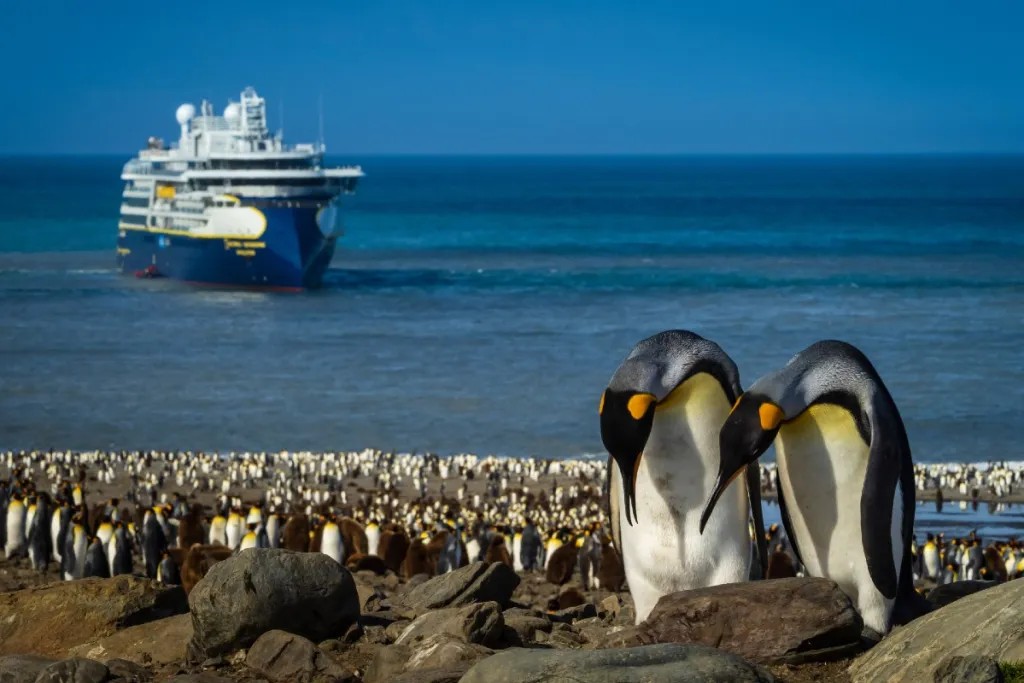
They went skiing toward a glacier. Found Emperor Penguins.
The expedition naturalist, Francesco, stopped them all. No plan. No ceremony.
Just a smile. A point in the distance where the ship disappeared. An invitation to just sit there.
Standing on Antarctic ice. Complete silence. Surrounded by penguins.
“It gave us all a completely different perspective,” Leahy says. “Our place within [the planet]…”
This is why the partnership with National Geographic matters. Scientists. Explorers. Storytellers. They aren’t extras on set. They are the main characters.
“The difference is shaped by science… and commitment that travel can be a driver of positive change,” Leahy says.
Built on legacy
This isn’t a new trick.
Lars-Eric Lindblad started it in 1966. He took the first citizen explorers to Antarctica. Back then it was like traveling to the moon. Few scientists went. Tourists definitely didn’t.
That history informs everything. Stewardship. Navigation knowledge. Relationships with communities built over decades.
It also fuels their wallet for conservation.
Through the Lindblad National Geographic Fund, guests directly pay for research. In 202 alone, the fund spent $3.0 million on conservation, science and storytelling projects. Including helping create three new Marine Protected Areas
More recently? Reintroducing extinct giant tortoises to Galápagos island. Over a decade of funding. More than $1 million spent. A milestone reached in February 202 six.
“People protect what they know,” Leahy argues. “That’s why exploration matters… Stewardship begins.”
The growth paradox
The category is massive potential but tiny current share.
Expedition cruising is less than 1 percent of global cruises.
Leahy sees this as a responsibility, not just opportunity.
“We’ll eventually run out extraordinary places explore,” someone asks her.
She laughs at that.
“Our planet is filled with remarkable destination… What matters expertise… to help experience them authentic way.”
For more information click here. 🌍


