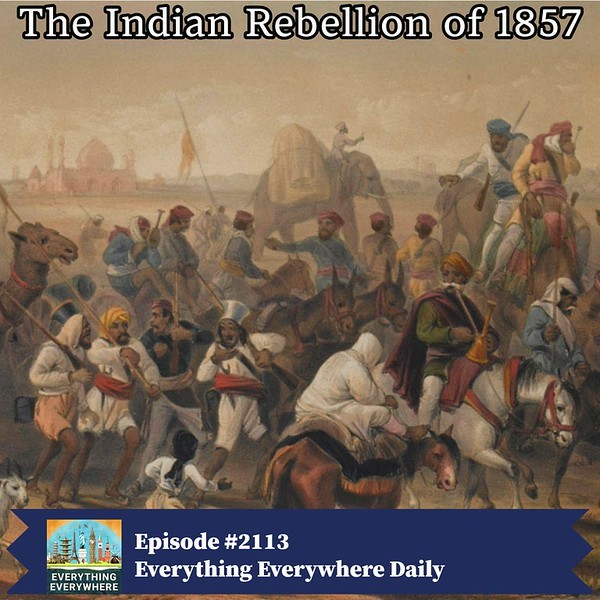
In 1857, a single rumor regarding the grease on rifle cartridges ignited a firestorm that nearly dismantled British colonial rule in India. What began as a localized military mutiny quickly spiraled into a massive, violent uprising that reshaped the geopolitical landscape of South Asia and brought an end to one of the most powerful corporate entities in human history.
The Rise of Corporate Sovereignty
To understand the scale of the rebellion, one must first understand the unique nature of British rule in India. Unlike traditional colonial governance, much of India was controlled not by the British government, but by a private corporation: the British East India Company.
Originally a group of merchants seeking trading rights in 1600, the Company evolved from a mercantile enterprise into a political powerhouse following the Battle of Plassey in 1757. By the mid-19th century, the Company operated as a sovereign state, commanding a massive standing army of approximately 280,000 Sepoys —Indian soldiers trained in British tactics and armed with British weaponry.
A Pressure Cooker of Grievances
The rebellion was not a sudden accident; it was the result of decades of simmering resentment across all levels of Indian society. The tensions can be categorized into three main areas:
- Political Disenfranchisement: Through the “Doctrine of Lapse,” the Company aggressively expanded its territory by seizing any princely state where a ruler died without a male heir, often refusing to recognize adopted successors.
- Economic Exploitation: The Company forced Indian peasants to pivot from essential food staples to industrial cash crops, such as indigo, to feed British textile mills. This, combined with heavy taxation, devastated the lower classes.
- Cultural and Religious Friction: The British began interfering in long-standing social customs and allowed Christian missionaries to flood the countryside, causing profound anxiety among Hindu and Muslim populations.
Even the Sepoys, the very backbone of Company security, felt the strain. They faced pay disparities, limited promotion opportunities, and a growing sense that their religious identities were being disregarded by their British officers.
The Spark: The Enfield Rifle
The immediate trigger was technical. The introduction of the Pattern 1853 Enfield rifle required soldiers to bite off the ends of greased paper cartridges to load them. Rumors—later supported by evidence of the era—spread that these cartridges were lubricated with a mixture of cow and pig fat.
For Hindu soldiers, the cow is sacred; for Muslim soldiers, the pig is prohibited. This perceived religious insult turned a military grievance into a holy war. The rebellion officially ignited when Mangal Pandey, a Sepoy, attacked British officers at Barrackpore. Though Pandey was executed, his defiance served as a catalyst for a much larger movement.
The Conflict: Chaos and Brutality
The uprising spread rapidly from Meerut to Delhi, where rebels sought to restore the legitimacy of the aging Mughal Emperor, Bahadur Shah Zafar. The conflict was characterized by intense, localized urban warfare in cities like Lucknow, Kanpur, and Jhansi.
The British response was marked by extreme violence. To instill psychological terror, British troops employed horrific tactics, such as “blowing from a gun”—a method of execution where prisoners were lashed to the muzzle of a cannon and executed. By the time the British and their Sikh allies recaptured Delhi in late 1857, the once-cosmopolitan city had been reduced to a wasteland.
One of the most enduring symbols of the resistance was Rani Lakshmibai, the Queen of Jhansi. After her kingdom was annexed under the Doctrine of Lapse, she became a legendary military leader, fighting valiantly until her death in 1858.
The Aftermath: From Company to Crown
While the rebellion failed to achieve its immediate goal of expelling the British, it fundamentally altered how India was governed. The British Parliament realized that a private corporation could no longer manage such a vast and volatile territory.
- The End of Corporate Rule: The Government of India Act of 1858 dissolved the East India Company’s political power, transferring direct control to the British Crown.
- Administrative Shifts: A new office, the Viceroy, was created to represent the monarch. The British also adopted a more conservative approach, promising to respect religious customs and princely states to avoid further unrest.
- Military Restructuring: To prevent future mutinies, the British altered the army’s composition, reducing the ratio of Indian to British soldiers and ensuring that all artillery remained under strict British control.
Conclusion
The 1857 Rebellion remains a deeply contested historical event. To the British, it was a “mutiny” caused by a breakdown in discipline; to Indian nationalists, it was the “First War of Independence.” While it failed to secure immediate freedom, it transformed the British Empire from a corporate venture into a direct imperial rule and provided the foundational myth of resistance that would eventually fuel India’s successful independence movement in 1947.