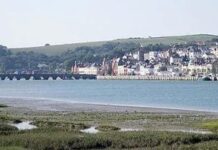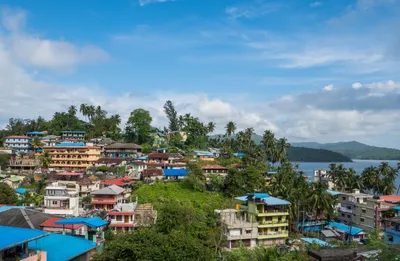
You are standing at the edge of the Bay of Bengal. The air is thick, the humidity is heavy, and the Andaman Sea is a few hundred meters away. This is Port Blair, the capital of the Andaman and Nicobar Islands. Locals often refer to it by its alternative name, Sri Vijaya Puram. It sits right between two major bodies of water, a logistical anchor for the region and a gateway to islands that feel worlds away from the mainland.
How Port Blair started: From survey to settlement
The city did not grow up organically. It was built. The British arrived in the late 18th century when India was under colonial rule. They had a specific goal. Control. The islands needed a presence that could watch over Malayan pirates and offer a safe harbor for ships wrecked in the waters.
Lord Charles Cornwallis, the governor-general of India at the time, had a plan. He asked two naval lieutenants, Archibald Blair and Robert Hyde Colebrook, to go look. In 1789, Blair did the work. He surveyed the largely unexplored places. He found a natural harbor. It looked good on paper and even better in person. He recommended a settlement at the mouth of that harbor.
The British listened. They established their first settlement that same year. They developed the harbor site Blair had chosen. For a while, the place was called Port Cornwallis. Then it was renamed Port Blair. It became a key naval base. It became an administrative center. It was meant to be a refuge.
It also became a prison. The British set up a penal colony. It did not last. By 1796, they abandoned the idea. They tried to move the colony to another site. That failed too. Disease was rampant. People got sick. People died. The project was deserted.
Why the Japanese occupation matters for your trip
You might wonder why the Japanese flag flew here in the 1940s. The city was occupied by the Japanese during World War II. It was a strategic hold. When the war ended, the British came back. Lord Mountbatten was the viceroy of India then. He oversaw the return.
This history is not just a footnote. It shapes the military presence you will see today. Port Blair has an Indian naval base called INS Jarawa. There is also a naval air station, INS Utkrosh. The city is not just a tourist hub. It is a strategic node.
Practical details: Population and geography
How big is the place? Not huge. In the 2001 census, the population was 99,984. By 2011, it grew to 108,058. It is a city of under 110,000 people. That means you will not be fighting for space in the cafes. You will not be stuck in massive traffic jams, at least not the kind you see in Delhi or Mumbai.
The location is distinct. Andaman and Nicobar Islands have been inhabited by indigenous Andamanese peoples for thousands of years. Long before the British came with their surveys and harbor plans, people were here. The history is layered. The indigenous presence
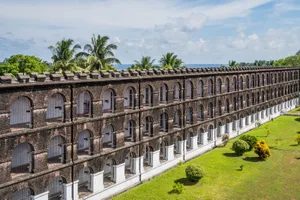
How the Cellular Jail became a symbol of resistance
The British didn’t build the Cellular Jail out of sudden cruelty. They needed space. After the 1857 rebellion, the prison population swelled, and the colonial administration revived the penal settlement at Port Blair. Between 1896 and 1906, they constructed the complex, explicitly modeling it on Pentonville Prison in London. The design was meant to isolate. It worked. Indian revolutionaries who fought for independence spent years in those cells.
The history doesn’t end with the British. In March 1942, the Japanese took South Andaman Island. Subhas Chandra Bose, who had allied with Japan, negotiated for the islands to be handed over to Azad Hind, his provisional government for “Free India.” In 1943, Bose hoisted the Indian flag over Port Blair. He declared it the first free territory of India.
That moment lasted less than two years. The Axis powers lost. The Japanese left. The British returned. But the flag had flown.
Why the city is being renamed Sri Vijaya Puram
In 1956, the islands joined independent India as a union territory. Port Blair became the capital. For decades, that name stuck. Then, in 2024, the Indian government decided to drop it. “Blair” carried too much colonial weight. They chose Sri Vijaya Puram instead.
The choice isn’t arbitrary. It links the islands to the Chola dynasty, the powerful rulers from southern India. Experts point to King Rajendra I, who used the Andaman and Nicobar Islands as a naval base. He launched a successful military campaign against the Srivijaya kingdom in Southeast Asia from there. The new name anchors the city in Indian history, not British administration.
Where the Japanese occupation left its mark
Port Blair sits on South Andaman Island. That specific location matters. It was the hub of the Japanese presence in March 1942. Bose’s declaration happened here. The British returned here. The union territory capital is here.
If you’re planning a trip, the Cellular Jail is the anchor. It’s not just a ruin. It’s a functioning museum site that tells the story of incarceration and independence. The Japanese occupation sites are less visible, but the narrative is woven into the local identity. The flag-raising spot is part of the broader historical walk.
What to know before you go
The rename is recent. You might see both names used, especially in older guides or digital maps. Sri Vijaya Puram is the official name now. But Port Blair is still recognizable. Don’t let the name change confuse your logistics.
The Cellular Jail tour is structured. You’ll move through cells, listen to recordings, see the architecture that mirrors Pentonville. It’s heavy, but necessary. The site is small enough to cover in a few hours, but the weight of it lingers.
Timing matters. The Indian summer heat is brutal. The island weather can shift fast. Plan your indoor visits, like the jail tour, for the midday heat. Save outdoor walking for the cooler mornings or late afternoons.
The Chola connection isn’t just a name. It’s a historical claim to sovereignty. When you stand in the city, you’re standing in a place where
Why the weather dictates your itinerary
You are looking at a city that sits 778 miles (1,255 km) off the Indian mainland, measured from Kolkata. From Chennai, the distance shrinks to about 738 miles (1,191 km). That is a lot of water to cross.
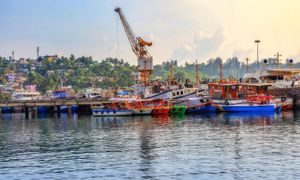
Sri Vijaya Puram hugs the southeastern coast of South Andaman Island. The terrain isn’t flat. The eastern, northern, and northeastern sections sit more than 100 feet (30 meters) above sea level. The west side drops off, sloping gently toward a natural harbor. It is a landscape shaped by elevation and water.
But the real factor is the monsoon.
When to go: avoiding the 120 inches of rain
The climate is hot, humid, and tropical. Temperatures barely blink. Highs hover around 86 °F (30 °C). Lows stay near 74 °F (23 °C). You will be warm regardless of the time of year.
The problem is the rain. The southwestern monsoon runs from May to October. During that stretch, the city soaks up roughly 120 inches (3,000 mm) of annual average precipitation. Heavy rains are the norm, not the exception.
If you want dry conditions, aim for October through April. These months are widely considered the most pleasant window for visiting.
Logistics and geography
The city’s position on South Andaman Island means you are dealing with a remote destination. The harbor to the west provides a natural entry point for vessels coming from the mainland.
- Distance from Kolkata: 778 miles (1,255 km) by sea
- Distance from Chennai: 738 miles (1,191 km) by sea
- Elevation: Over 100 feet (30 meters) in eastern, northern, and northeastern areas
- Rainfall: ~120 inches (3,000 mm) annually, concentrated May–October
- Best window: October–April
Is it worth the travel? That depends on whether you can tolerate humidity that never quite breaks. The heat is constant. The rain is seasonal but intense. If your travel dates fall outside the monsoon, you get a tropical city with a view of the Andaman Sea, perched on hills that look out over a harbor carved by nature.
Getting to Port Blair and Navigating the Island
You have two ways to reach the archipelago. Fly into Veer Savarkar International Airport or take a passenger ship to Haddo Wharf. Ships depart from Kolkata, Chennai, and Visakhapatnam. Choose the flight if you are short on time. Take the boat if you want to watch the horizon dissolve into the sky before you even touch down.
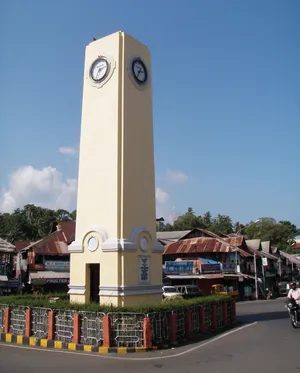
The city itself feels like a pause button for the rest of the country. It is the administrative hub and the main jumping-off point for the Andaman and Nicobar Islands. The architecture tells a colonial story. Look for the timber homes built on raised platforms with tin roofs. They cluster around Aberdeen Bazaar. That bazaar is the heart of the town. Hotels, shops, and bus depots all orbit that specific corner.
Historical Weight and the Cellular Jail
History here is not a backdrop. It is the foreground. The Cellular Jail stands as the most intense historical landmark in the region. It was a prison for political detainees during the freedom struggle. Vinayak Damodar Savarkar, Barindra Kumar Ghosh, and Ullaskar Dutta all spent time inside its walls.
The conditions were brutal. Prisoners referred to the experience as Kalapani ki Saza, or “Black Water Punishment.” It was a place of isolation and suffering. Standing there now, with the sea breeze hitting your face, you can feel the weight of that history. It is not a place you visit for a quick photo op. It requires a moment of stillness.
Museums, Wildlife, and Local Flavors
Beyond the heavy history, the city offers lighter, more practical points of interest. You can explore the Samudrika Naval Marine Museum, the Anthropological Museum, or the Fisheries Museum. Each covers a different slice of life in the islands.
Nature is close by. Chidiyatapu Biological Park acts as a mini-zoo. It houses rare bird species. If you are interested in agriculture, head to Sippighat Farm. It is a government facility focused on spice cultivation.
For relaxation, Corbyn’s Cove is your best bet. It sits northeast of the central city area. It is a beach. You can swim, sit, and let the waves wash away the heat. Marina Park offers another green space for a walk.
Excursions Beyond the City Center
Do not stay confined to the city limits. Three locations nearby are essential visits.
- Chatham Sawmill: Located on Chatham Island, this is one of the oldest sawmills in Asia. It is a piece of industrial history that survived the centuries.
- Viper Island: The ruins of a jail sit atop a hill here. It is a stark, atmospheric location.
- Madhuban: A forested area perfect for a quiet walk away from the city noise.
If you want to leave the mainland for a day, three nearby islands are open to visitors. Netaji Subhash Chandra Bose Dweep (formerly Ross Island) features colonial ruins. Swaraj Dweep (formerly Havelock Island) is famous for its beaches. Jolly Buoy is another popular destination for short trips.
Festivals and Cultural Timing
The cultural calendar in Port Blair is active. You should plan your trip around the major festivals if you want to see the local community in motion.
The Island Tourism Festival is the biggest draw. It typically runs in December or January. The main venue is the ITF Ground. Expect traditional dance, music, art, and local food. It is a celebration of island identity.
The Monsoon Tourism Festival usually happens in July. It is a different vibe, catering to the wet season.