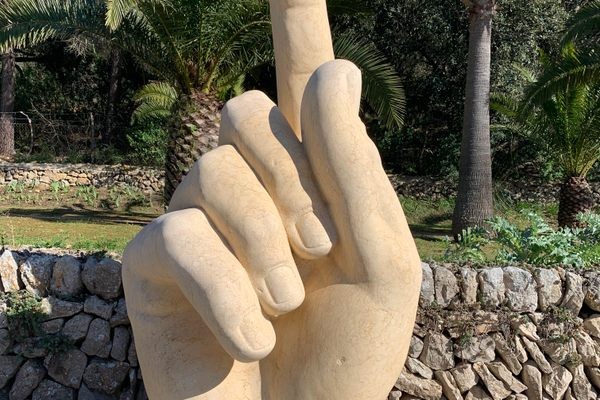
Finding the Museo Sa Bassa Blanca in Alcúdia, Mallorca, requires a surrender to uncertainty. While a signpost at the Port d’Alcúdia roundabout marks the start of the journey, the final five kilometers are a test of patience and vehicle durability. The road narrows into a dusty, pothole-ridden lane flanked by precarious stone walls. It winds through the rugged La Victoria peninsula before descending back toward the sea. The address itself, “Es Mal Pas” (The Bad Path), is less a warning and more an artistic statement—a literal and metaphorical threshold that separates the mundane tourist trail from a hidden cultural sanctuary.
A Surreal Welcome
Upon passing through the museum gates, the logic of the everyday world dissolves. The sculpture garden begins not with a plaque, but with a series of disorienting encounters. To the left, a Virgin Mary stands in a stone archway, her form rendered entirely in azure blue—a striking departure from traditional Catholic iconography. Behind a nearby hedge, a silver figure that initially resembles an alien resolves into a giant octopus. Further along, a stone cross reaches out in multiple directions, while a decommissioned Nissan pickup truck has been repurposed into a vibrant flower planter.
The confusion peaks with four red bicycles, their rear frames welded together and pointing toward the four cardinal directions. These are not random detritus; they are the first six of exactly one hundred sculptures that comprise the museum’s outdoor collection. This eclectic mix raises immediate questions: Is this a commentary on consumerism? A critique of political stagnation? Or simply a playful rebellion against conventional aesthetics?
The Architects of the Dream
The garden is the brainchild of a foundation established in 1993 by artist couple Yannick Vu and Ben Jakober, alongside Georges Coulon Karlweis. The couple had acquired the land in 1978, but their vision required significant resources and expertise.
- Yannick Vu: Born in France in 1942 to Vietnamese parents, Vu is a painter, sculptor, and designer who has called Mallorca home since 1963.
- Ben Jakober: A Jewish-Hungarian sculptor born in Austria in 1930, Jakober fled National Socialism as a child, eventually settling in England. Before turning to art, he enjoyed a successful career as a banker at Rothschild—a tenure that likely provided the financial stability needed to realize this ambitious project.
In 1978, they enlisted the renowned Egyptian architect Hassan Fathy to design the main residence. The result is a structure built in the style of a Nubian palace, blending Mediterranean warmth with North African architectural traditions.
Art for the Senses
What distinguishes the Museo Sa Bassa Blanca is its intentional distance from the island’s mass tourism circuit. While package tours often prioritize sun, sand, and consumption, this garden appeals to a more contemplative audience. Approximately 90% of the works were created by Vu and Jakober themselves, utilizing a diverse range of materials including granite, metal, sandstone, clay, steel, and mosaic tiles.
The collection is heavily focused on stylized animal figures. Unlike traditional museum pieces that demand “look but don’t touch,” these sculptures invite interaction. Children climb on rhinoceroses and dromedaries, while polished steel and stone spheres and cones act as funhouse mirrors, distorting reflections and engaging the viewer physically.
Humor, History, and Hope
The garden is not merely decorative; it is intellectually and emotionally layered. Some works are overtly humorous, such as a tombstone inscribed with “I’m still alive” and another at the garden’s exit reading “The End.” A sculpture titled “The Death of Marat” depicts a deceased tennis player—a possible ironic nod to the boom in sports tourism that has both enriched and strained Mallorca’s infrastructure.
Land art features also play a role, with a stone spiral and a circle of rocks modeled after Stonehenge integrating the artworks into the natural landscape. The grounds themselves are meticulously landscaped, featuring olive groves, date palm avenues, a brick tower draped in climbing plants, and a rose garden. In a poignant touch, Yoko Ono planted one of her Wish Trees here, allowing visitors to hang notes containing hopes for a better world.
A Complete Cultural Experience
The sculpture garden can be visited independently of the main museum for a modest fee, making it an accessible entry point for casual tourists. However, the full experience includes the main house, which houses:
* A collection of contemporary art.
* The “Sala dels NINS”, an underground gallery featuring historical portraits of noble children.
* The Socrates Room, dedicated to an ethnographic collection.
Conclusion: The Museo Sa Bassa Blanca is more than an art gallery; it is a testament to the power of creative vision in remote spaces. By transforming a difficult-to-reach location into a sanctuary of surrealism and interaction, Vu and Jakober have created a place that challenges perceptions and invites deep, personal engagement with art.