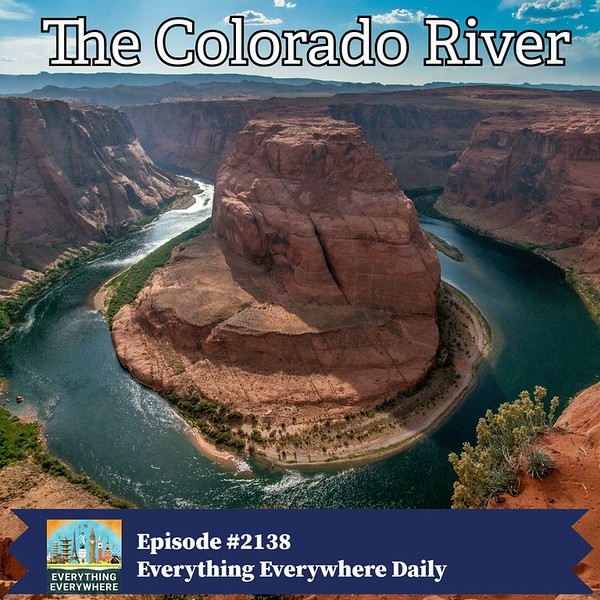
The river didn’t build the West. It was leased out before we knew what it could pay.
Subscribe
Apple | Spotify | Amazon | iHeart Radio | Castbox | PodcastRepublic | RSS | Patreon | Discord
Podcast Transcript
It cuts a path of 1,400 miles. Carves drama. Feeds cities. And then runs dry.
The Colorado River is the skeleton of the American Southwest. It shaped the canyons we photograph and the farms that feed us. But mostly it’s the center of a fight we’ve been having since the 1920s and haven’t really resolved since.
From the Rockies to the Gulf. That’s the range. But the reality? It stops way before the ocean now.
Stone and Rain
The landscape is insane. You’ve got Zion. Bryce Canyon. Arches. The Grand Canyon further down.
These aren’t just pretty views. They’re engineering projects done by water. About 70 million years ago tectonic plates pushed up. The Colorado Plateau rose. Then the water started cutting through.
Rocky dry ground. Intense heat. Little vegetation means rain doesn’t soak in. It runs. It cascades.
Summer monsoons help sure enough. Thunderstorms hit hard afternoons. But they’re the side hustle. Nearly 90% of the flow comes from snowmelt up in the Rockies. Mountains matter.
The water drops 12,00 feet from source to sea. Fast moving. Muddy. Which explains the name.
Rio Colorado. Spanish for reddish. The early explorers saw the iron oxide stains on the banks. North of the Grand canyon they called it the Grand River. Until 1921 when a congressman named Edward Taylor told everyone to just pick one name. Colorado won.
Today it’s blue-green. Why? Because the dams caught the silt. The dirt is trapped upstream. The red is gone.
The Thirsty Population
Here’s the number that matters: 30 million people rely on this water. Denver. Los Angeles. Phoenix. Las Vegas.
But cities aren’t the biggest users.
Farmers are. Nearly 80% of the annual flow goes to irrigating 3 million acres.
That’s a problem. We’ve been in a megadrought for 25 years. Tree ring data says this is the driest stretch in 800 years.
Look at Lake Powell. It’s at 23% capacity. Lake Mead is sitting at 31%.
There’s a white ring on the cliffs. A bathtub ring. It shows you where the water used to be.
Water is the asset. Drought is the liability.
The Broken Math of 1922
The rules governing the river are called the Law of the River. It’s a mess of compacts and court cases. And the math was wrong from the start.
The 1922 Colorado River compact divided the basin into two parts: Upper and Lower. Each gets 7.5 million acre feet of water annually. Total: 15 million.
Except.
Here’s the thing they didn’t tell you. 1914 through 1923 was the wettest ten year period in a century. They signed a contract based on a record-breaking windfall as if it was normal.
The river averages 18 million acre feet in those good times. Today it averages 13 million.
We’re drinking our future.
Herbert Hoover brokered the peace. He split the region. He tried to calm the Upper basin states who were scared of the new Hoover Dam limiting their access. The solution? Just take half. Even though there wasn’t enough to go around.
The Lower Basin Squeeze
The Lower basin has Arizona California and Nevada. They hold the economic cards.
Their population is three times larger than the Upper basin’s. Their agriculture is bigger. Their industry is heavier. They have the power.
The compact guaranteed water delivery regardless of weather. So even in dry years the Lower basin took their full allocation. The Upper basin had to tighten the belt. Since 2015 they’ve averaged just 4.5 million acre feet annually while the Lower basin keeps theirs.
And what about Mexico?
The 1944 amendment gave them 1.5 million acre feet. They get almost nothing now. The water disappears before it hits the border.
Use It Or Lose It
Why is no one fixing it?
Because the incentives are perverse. In the west if you don’t use your water rights you might lose them. “Use it or lose it” is the law in many states.
So farmers flood-irrigate desert dirt. They grow cotton. They grow alfalfa. Crops that need gallons. They waste water to keep the legal right to water.
Water is subsidized. It’s cheap. It’s effectively free in some places. So why change?
Conserving water hurts your legal claim. It’s insane. But it’s how the system works.
Indigenous communities suffer too. Thirty-four reservations rely on the system. But their rights are tangled. Conflicting agreements. Federal promises that got canceled by adjacent deals.
Infrastructure At Risk
Shannon Mullane writes for the Colorado Sun. She points out something beyond thirst.
If Lake Powell gets too low the infrastructure fails. The intake gates for the Hoover Dam will sit above the surface. No more hydroelectric power. That means the affordable renewable energy grid for the West goes dark.
It’s not just about farms. It’s about lights staying on.
We dammed this river harder than any other in history. We diverted it. We argued over every drop.
We created a legal system based on rain that won’t come. We divided a pie that shrank while we were cutting the slices.
The river sustains tens of millions. It carved the most beautiful places on Earth.
But it’s bleeding out. The question isn’t if we can fix the physics. Gravity works the same as it always did. The question is whether we can fix the politics before the pumps run dry.
We built an empire on a loan from nature. The collection agency is coming. And it’s bringing a drought.
Does anyone actually want to pay back the water?
Or will we just argue over the dust?