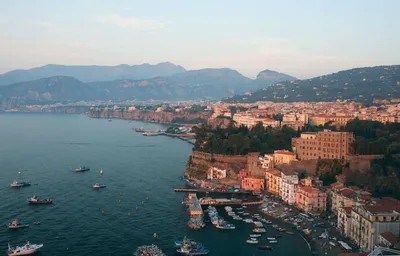
Sorrento is located on a rocky ridge deep in the Tyrrhenian Sea. It’s a place that feels cut out of the landscape rather than built upon it. The city opens onto the Gulf of Naples in the north and the Gulf of Salerno in the south. You are looking at geography that needs attention.
This is more than just a pretty background. This is a strategic point. The center of the peninsula is the Lattari Mountains. They rise steeply behind the city. The highest peak, Mount Sant’Angelo, is 4,734 feet above sea level. It’s 1,443 meters of limestone and drama. The landscapes of Sorrento are more than just a view. It’s defensive. This is historic.
The name itself refers to the layers below. To the Romans, Sorrento was Surrentum. But the roots are much deeper. The Greek origins may be here. The Romans saw what the Greeks had already seen – a resort whose scenery could cure almost any ailment. Or at least divert your attention from the plague you’re trying to escape.
Medieval history did not ignore this place. It existed as an autonomous principality in the seventh century. The change of power continued in southern Italy. The Normans arrived later. They occupied it in 1137 and the Kingdom of Sicily expanded. The Sorrento became part of this larger machine. It has survived invasion, epidemics and earthquakes. It retains its charm.
Culture followed the conquests. The famous poet Torquato Tasso was born here in 1544. He was more than just a resident. He was the product of this specific intersection of Mediterranean heat and intellectual pressure.
Why Sorrento is still a strategic gateway
Most travelers use Sorrento as a base. They did not stay long enough to understand the peninsula’s role in regional control. Geography determines logistics. If you leave Naples, you continue in a south-southeast direction. You drive along the coast. Driving takes time. The road is windy. It’s not just about getting from point A to point B; It descends into a valley.
The Latari mountains act as a barrier. They keep the town distinct. You cannot feel the vastness of Naples. You can’t really feel Salerno’s industrial roots. You will see a concentration of old stone and lemon trees. Height helps. It keeps the summer heat at bay. At least it lets the wind through.
Layers of history beneath the surface
To understand why the Sorrento is important, you have to looking at the timeline. This is more than just a passive resort. It’s a fortress. Then a duchy. Next up is Norman holding. Each level increases defenses and cultural integration.
The Greek influence is subtle. There are no temple ruins in the central square. But the layout of the city suggests it. The street seems to be along the slope. in the direction of the house. This is a practical adaptation to the terrain.
The Roman era is more than just a name. Surrentum is a resort. Wealthy Romans came here. They wanted an sea view. They want fresh air. They wanted to distance themselves from Roman politics. This tradition continues. The rich keep coming. they
What to watch when the sun goes down
You can’t talk about the Sorrento without talking about the elephant in the room. This is a resort town. Everyone knows that. You know it. But that doesn’t mean you shouldn’t go. This means you need to know where to look. The crowds stick to the water’s edge. The real texture of this place is the inland.
Let’s start with the cathedral. It has been rebuilt countless times. Each iteration adds layers of history. Or maybe it just gives you an extra excuse to renovate. That’s not the main reason to come here. But it’s there. It anchors the center.
From there we walk to the cloister of St. Francis of Assisi. The date is the 14th century. The building is quiet. A stark contrast to the hustle and bustle of main drag. You can sit there. You can hear the wind blowing in the stone. It’s one of those spots that exists just to stop you.
Next is the Correale di Terranova Museum. Don’t skip this. Most travelers walk past it. They chase the shore. They miss the Campanian decorative art of Campania inside. The collection is significant. medieval sculpture. Painting. Classical remains. This is not a large museum. It is dense. It demands attention. If you’re interested in what southern Italy was like before picture postcards, you’ve come to the right place.
The taste of the coast
Sorrento sold its soul to tourism a long time ago. However, the ingredients remain unchanged. That’s the most important thing. The wine. olive oil. citrus fruits.
Local wines are sold in every small shop. They are not expensive. They are not world famous. But they taste like the place. Let’s drink them. Eat them. Olive oil is sharp. It cuts through the heaviness of a rich meal. Citrus fruits are aggressive. It’s bright. It wakes you up.
In 2006, the population was 16,565. This number may have changed. it doesn’t matter. The city is small and you can walk it in one afternoon. But it’s big, so you might get lost. The streets are winding. They drop down toward the sea. They climbed back up the mountain.
Why do people keep coming back? Is it the climate? perhaps. The atmosphere here is different. It’s heavy. It smells like salt and lemon. Or perhaps architecture? A rebuilt cathedral. old cloister. The museum is full of fragments from different eras. Maybe that’s it. Maybe it is none of it.
You find yourself standing on a balcony. You can see changes in the light on the surface of the water. You are probably thinking about your next city. And then you will forget about it. You will stay for one more night. Just to see the museum again. Or to taste the wine. The logic of travel rarely stands up to scrutiny.