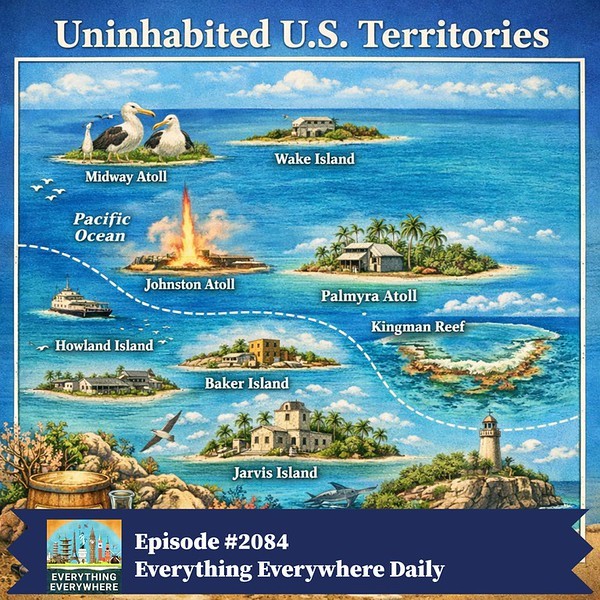
The United States controls more land than many realize – including islands most Americans have never heard of. In 1856, a law was passed allowing U.S. citizens to claim unclaimed islands in the country’s name, as long as no other nation had a claim and the islands were uninhabited. This led to a scattering of remote territories becoming part of the U.S., largely forgotten by the public. Today, these islands remain U.S. possessions, a consequence of an old policy driven by an unexpected resource: bird droppings.
The Guano Act and the Race for Bird Poop
The key to understanding these claims lies in the Guano Islands Act of 1856. At the time, guano – accumulated bird manure – was a highly valuable commodity used as fertilizer and in gunpowder production. If a U.S. citizen discovered an unclaimed island with guano deposits, they could claim it for the U.S., with military backing if necessary. This sparked a wave of American expansion across the Pacific and Caribbean, claiming many small, remote islands.
The policy was efficient: the government didn’t need to invest directly, as private citizens did the work. No conflicts arose because only unclaimed islands were taken, and no native populations needed to be displaced. However, guano is a finite resource. Once exhausted, many of these islands became strategically useless.
The Equatorial Islands Colonization Project
By the 1930s, the U.S. government grew concerned about losing control of these claims, especially as Japan expanded in the Pacific. The American Equatorial Islands Colonization Project was launched: a quiet effort to establish a human presence on these islands to solidify U.S. territorial claims.
The goal wasn’t settlement; it was assertion of sovereignty. Young American men, mostly from Hawaii, were sent in small groups to raise flags, collect weather data, and maintain a continuous occupation. Conditions were brutal: extreme isolation, limited supplies, and no fresh water. The project ended in 1942 after Japanese attacks during WWII killed some colonists and forced evacuation, and the U.S. never seriously attempted permanent civilian settlement again.
Caribbean Outposts: Navassa, Bajo Nuevo, and Serranilla
The Caribbean holds a few of these territories. Navassa Island, claimed in 1857 for guano mining, briefly supported a mining community before being abandoned. Today, it’s a wildlife refuge, though Haiti disputes U.S. ownership.
Two other reefs, Bajo Nuevo Bank and Serranilla Bank, are also claimed by the U.S., but recognized only by a few nations. The International Court of Justice has ruled in favor of Colombia’s control of both reefs, though the U.S. and Jamaica don’t recognize the ruling.
Pacific Remnants: Wake, Midway, and Johnston Atoll
The Pacific holds the bulk of these forgotten territories. Wake Island, first sighted in the 16th century, gained importance as a refueling stop for transpacific flights and later as a military outpost. It saw fierce fighting in WWII and remains under U.S. control as a highly restricted military base.
Midway Atoll, annexed in 1867, became famous for the Battle of Midway in 1942, a turning point in the Pacific theater. Today, it’s a wildlife refuge with limited access.
Johnston Atoll was a key Cold War military installation, including a nuclear test site. The 1962 Starfish Prime test detonated a nuclear device above the Earth, causing widespread disruptions. The atoll later housed a chemical weapons disposal facility before being abandoned in 2004 and becoming part of a wildlife refuge.
Palmyra, Kingman, Jarvis, and Howland: The Last Remnants
Palmyra Atoll, unique among these territories, was designated an incorporated territory with full U.S. constitutional rights. It passed through private ownership before being largely taken over by The Nature Conservancy for research and conservation.
Kingman Reef, Jarvis Island, and Howland Island were all claimed under the Guano Islands Act, briefly mined for guano, and abandoned. Howland Island is notable as Amelia Earhart’s intended destination during her final flight.
Today, these islands are mostly wildlife refuges, with infrastructure decaying and access highly restricted. They have no economic value and serve no strategic purpose beyond symbolic U.S. possession.
Despite being remote, uninhabited, and largely unknown, these islands remain part of the United States, a legacy of a 19th-century expansionist policy driven by an unlikely resource: bird poop.