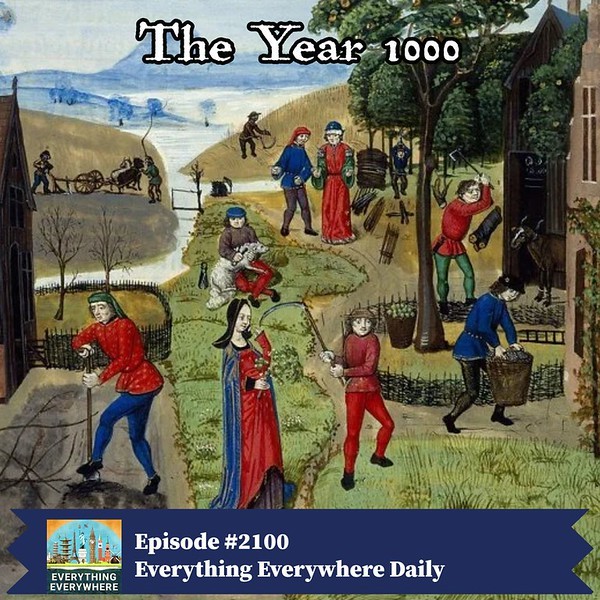
The year 1000 was not merely a milestone on a calendar; it was a moment of profound global diversity and shifting momentum. While popular myth often paints this era as a period of superstitious dread in Europe, the historical reality reveals a much more complex picture: a world of rising empires, scientific golden ages, and the very first, fragile threads of global connectivity.
The Myth of the “Medieval Y2K”
A common historical trope suggests that Europeans in the year 1000 lived in terror of the apocalypse, fearing the end of the world as the millennium turned. However, modern scholarship suggests this “medieval Y2K” panic is largely overstated.
Because the Anno Domini calendar system was not yet standardized, many people likely didn’t even realize it was a significant turning point. While Christianity was expanding—notably through the Christianization of Hungary and Iceland—Europe remained a fragmented landscape. Western Europe was characterized by small agrarian economies, the slow consolidation of feudal domains in France, and a Papacy struggling with corruption and political instability during the so-called saeculum obscurum.
Centers of Power and Innovation
While Europe was slowly recovering from earlier declines, other parts of the world were experiencing massive intellectual and economic booms.
The Islamic Golden Age
The Islamic world was arguably the most intellectually vibrant civilization on Earth. From the libraries of Córdoba —then one of the world’s largest and most advanced cities—to the scientific hubs of the Middle East, scholars were laying the foundations of modern science.
– Ibn al-Haytham was revolutionizing the study of optics.
– Avicenna and other polymaths were advancing medicine and philosophy.
– The era was defined by the reach of the Abbasid, Fatimid, and Cordoban Caliphates, creating a vast network of shared knowledge.
The Song Dynasty: A Technological Titan
In East Asia, China’s Song Dynasty stood as the world’s technological leader. This was a “pre-modern” commercial society characterized by:
– The widespread use of gunpowder, the compass, and printing.
– A thriving merchant class and a merit-based civil service.
– A massive export economy that moved paper and books across borders.
The Byzantine and Indian Empires
To the East, the Byzantine Empire remained a sophisticated bastion of power under Emperor Basil II, acting as a bridge between Europe and Asia. Meanwhile, in Southern India, the Chola Dynasty emerged as a formidable maritime power, projecting influence across Southeast Asia through vast trade networks.
The Americas and the Pacific: Uncharted Frontiers
While Afro-Eurasia was connecting through trade, the Americas and the Pacific were home to thriving, independent developments.
- The Americas: In Mesoamerica, the Maya were still vital despite being past their “classic” peak, centered in cities like Chichén Itzá. In the American Southwest, the Ancestral Puebloans were constructing sophisticated stone complexes in places like Chaco Canyon.
- Polynesian Expansion: Some of the greatest feats of navigation were occurring in the Pacific. Using sophisticated knowledge of stars and ocean currents, Polynesian explorers were settling vast stretches of the ocean, reaching islands like Hawaii.
- The Norse Arrival: One of the most significant, albeit brief, disruptions occurred when Leif Erikson landed in Newfoundland (modern-day Canada). While this Norse settlement did not lead to lasting contact between the hemispheres, it stands as a remarkable moment of transoceanic exploration.
The Dawn of Globalization
Perhaps the most important takeaway from the year 1000 is not found in any single empire, but in the way these distant worlds began to touch.
Historians like Valerie Hansen argue that this era marks the beginning of early globalization. It wasn’t a single, unified global economy, but rather a period where regional trade networks—driven by merchants and maritime improvements—began to stitch together the Islamic world, China, Europe, and Africa.
The year 1000 represents a pivot point: the transition from isolated regional pockets toward a more continuous, interconnected system of exchange for goods, ideas, and technology.
Conclusion
The year 1000 was a world of stark contrasts, where the “Dark Ages” of Europe were ending and the scientific and commercial heights of the Islamic and Chinese worlds were peaking. It was a period that laid the groundwork for the interconnected, globalized reality we inhabit today.