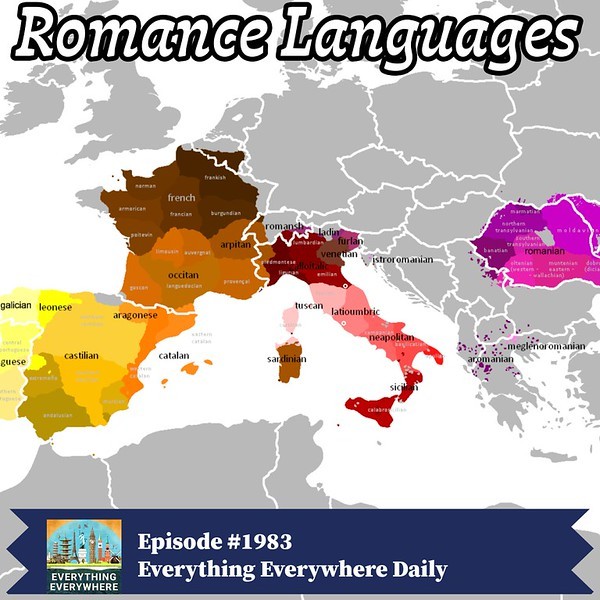
Nearly a billion people worldwide speak a language rooted in Latin – a Romance language. While Spanish, Portuguese, French, Italian, and Romanian dominate the landscape, a vast network of smaller, often overlooked languages persists, each with its own unique history and cultural significance. This article explores the evolution of these languages, from their origins in Vulgar Latin to their fragmented distribution across Europe and beyond.
The Latin Legacy: From Empire to Divergence
The Romance languages descend directly from Vulgar Latin, the colloquial form used by common people throughout the Roman Empire. This differs sharply from Classical Latin, preserved in scholarly texts, which remained relatively stable. Vulgar Latin, however, was fluid, evolving rapidly across the empire’s regions. As Roman legions expanded from the 3rd century BC through the 5th century AD, they spread Latin, often displacing or influencing local tongues.
The fall of the Western Roman Empire in the 5th century triggered rapid linguistic divergence. Geographic isolation, limited literacy, and influence from pre-Roman languages accelerated this process. Visigoths, Franks, and Lombards all left their mark on the evolving dialects. By 1000 AD, these regional variations had become mutually unintelligible, solidifying into distinct languages. Early evidence appears in documents like the Oaths of Strasbourg (842) – recorded in Old French and Old High German – and the 8th-9th century Veronese Riddle, written in an early form of Italian.
Despite this splintering, Latin remained the common language for scholarship and official writing throughout the Middle Ages.
The Major Players: A Global Reach
The Age of Exploration dramatically expanded the reach of Romance languages, beginning in the 15th century. Spanish and Portuguese colonization spread these tongues across the Americas, while French expanded into Africa, Southeast Asia, and the Caribbean.
Today, the most prominent Romance languages include:
- Spanish: Spoken by 475-500 million native speakers, predominantly in Spain, Mexico, and Central/South America.
- Portuguese: Claimed by 230-260 million speakers, with Brazil accounting for the majority.
- French: Native to 75-80 million, with an additional 200 million secondary speakers across Francophone Africa.
- Italian: Spoken by 65-70 million, primarily in Italy and Switzerland.
- Romanian: The major Eastern Romance language, with 24-26 million speakers in Romania and Moldova.
Beyond the Big Five: A Landscape of Smaller Tongues
The distribution of Romance languages is far more complex than many realize. Switzerland, for example, recognizes four official languages: German, French, Italian, and Romansh. This Alpine language, spoken by a few thousand people in Graubünden, preserves archaic Latin features shaped by centuries of isolation.
Italy itself harbors numerous regional languages beyond standard Italian. Over half of all Italians don’t speak Italian at home. What’s considered “Italian” today largely stems from the Florentine dialect championed by Dante Alighieri. Until the 19th century, Italy was fragmented, allowing strong regional dialects to flourish; even after unification in 1861, only 2.5-10% of the population spoke standard Italian.
Some notable lesser-known languages include:
- Sardinian: Closest to early Latin, spoken on Sardinia by roughly a million people.
- Friulian & Ladin: Found in northeastern Italy, influenced by Germanic and Slavic neighbors.
- Sicilian & Neapolitan: Distinct Romance languages with rich literary traditions, often spoken alongside Italian.
- Venetian & Lombard: Regional tongues with unique vocabularies and syntax.
Spain also has its hidden linguistic diversity. Catalan, spoken in Catalonia, Valencia, and the Balearic Islands, has approximately 9.2 million speakers. In northwestern Spain, Galician descends from medieval Galician-Portuguese. In the Pyrenees, the Aranese dialect of Occitan has official status in Catalonia.
The Romanian Anomaly: A Balkan Outlier
Romanian stands apart as the only major Romance language isolated in Eastern Europe. While the Roman Empire once encompassed much of the Balkans, Slavic migrations in the 6th-7th centuries led to the decline of Romance languages in the region.
Languages like Dalmatian (extinct since 1898) and Mozarabic (spoken under Muslim rule in medieval Iberia) have faded into history, leaving Romanian as a linguistic outlier.
A Legacy of Fragmentation
The evolution of Romance languages demonstrates how empires fragment, languages diverge, and cultural identities solidify. What once was a spectrum of interconnected dialects has consolidated into a few dominant tongues, leaving behind a rich tapestry of smaller, often endangered languages. These minor Romance languages, though overlooked, remain a vital part of millions of lives.