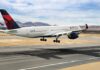
Two commercial aircraft narrowly avoided a collision at Newark Liberty International Airport on Tuesday evening, prompting investigations by the Federal Aviation Administration (FAA) and the National Transportation Safety Board (NTSB). The incident involved an Alaska Airlines Boeing 737 arriving from Portland, Oregon, and a FedEx Boeing 777 inbound from Memphis.
Close Proximity on Intersecting Runways
At approximately 8:15 p.m., air traffic control instructed the Alaska Airlines pilot to abort their landing. This decision came as the FedEx cargo plane had already been cleared for its final approach to an intersecting runway. Preliminary data from Flightradar24 suggests the Alaska Airlines plane cleared the FedEx aircraft by just 300 to 325 feet vertically – a dangerously small margin.
Standard Procedures, Critical Timing
Both airlines released statements following the incident. Alaska Airlines emphasized that its pilots are extensively trained to execute “go-arounds” when instructed by air traffic control. The FAA characterizes this maneuver as a standard safety procedure, allowing pilots to safely re-attempt a landing. FedEx confirmed that its crew landed without incident after following air traffic instructions.
Recurring Concerns at Newark Airport
This near-miss follows a similar incident at Newark just two weeks prior, in which a Singapore Airlines plane struck the tail of a Spirit Airlines aircraft while taxiing. The close succession of these events raises concerns about potential vulnerabilities in air traffic management at the busy airport. Newark is one of the most congested airspaces in the United States, and these incidents highlight the constant vigilance required to maintain safety.
The FAA and NTSB investigations will determine whether procedural errors, equipment malfunctions, or human factors contributed to the close call. Until then, the event serves as a stark reminder of the critical role air traffic control plays in preventing disasters.
The investigations will likely review communication logs, radar data, and pilot decision-making to understand precisely how the situation unfolded and prevent future occurrences.