The traditional vocabulary of travel is overwhelmingly visual. We speak of “sightseeing,” “scenic vistas,” and “must-see” landmarks, operating under the unspoken assumption that the world is best understood through the eyes. But for the millions of people living with visual impairments, this definition is not just narrow—it is exclusionary.
A recent 10-day journey through India’s Golden Triangle with Traveleyes —a specialized tour company—challenges this paradigm. By pairing visually impaired (V.I.) travelers with sighted companions, the program moves away from the concept of “sightseeing” and toward a model of multisensory immersion.
The Traveleyes Model: Companionship Over Caregiving
Founded in 2004 by Amar Latif, who lost much of his sight to retinitis pigmentosa, Traveleyes was born out of necessity. Mainstream tourism often treats visually impaired travelers as liabilities, frequently requiring them to bring expensive caregivers or barring them from adventurous activities.
Traveleyes operates on a unique, reciprocal social contract:
– Sighted travelers act as navigators and “visual narrators,” describing the world in exchange for discounted travel.
– Visually impaired travelers bring a heightened awareness of sound, scent, texture, and spatial acoustics, offering a perspective that often deepens the experience for their sighted partners.
The goal is not to “help” a person in need, but to engage in a shared exploration. However, as the journey revealed, this requires a delicate social balance. Some travelers noted that sighted guides can sometimes fall into a “caregiver” trap—treating V.I. adults like children or being overly cautious. Success in this model relies on a “complex dance” of mutual respect and independence.
A World Defined by Scent, Sound, and Texture
In a place like India, where the sensory input is constant and intense, the limitations of sight become secondary to the richness of other senses. The trip demonstrated how different travelers navigate this “sensory onslaught”:
1. The Architecture of Sound
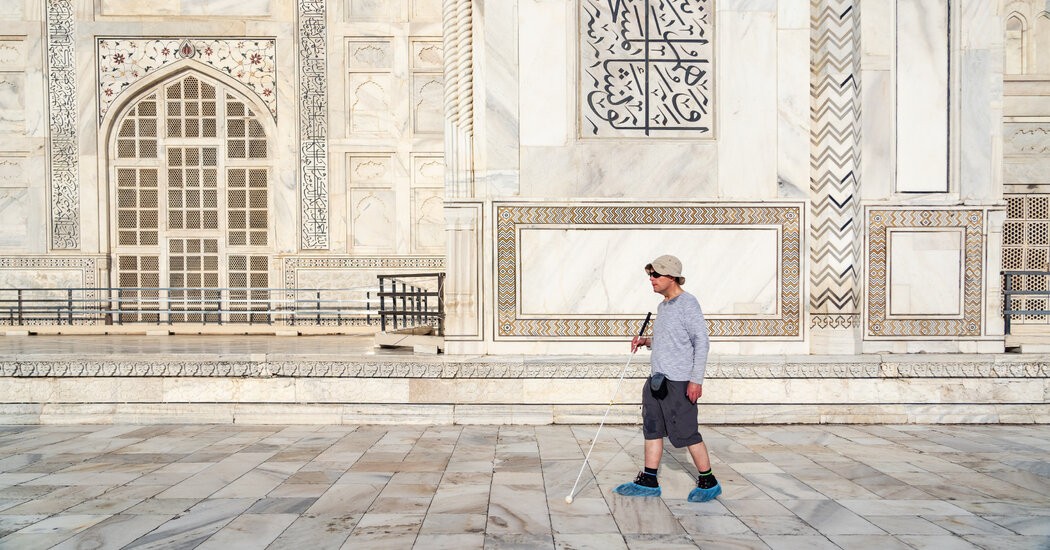
Inside the Taj Mahal, the experience shifts from the visual majesty of white marble to the auditory magic of the dome. Travelers noted how the acoustics transform ambient noise—the murmur of crowds and quiet conversations—into a low, resonant hum, much like a continuous chant. For a blind traveler, the building isn’t just a monument; it is a vessel for sound.
2. The Texture of Reality
Tactile engagement becomes a primary way to “see” the world. This includes:
– Running fingers over the raised stripes of a tiger figurine to understand its scale.
– Feeling the difference between rough sandstone and smooth marble underfoot.
– Handling the distinct textures of colorful, patterned Indian rupee notes.
– Exploring miniature reed islands on Lake Titicaca or touching (with rare permission) the Terra-cotta Warriors in China.
3. The Narrative of Human Behavior
For many V.I. travelers, “scenery” is less interesting than “humanity.” Rather than wanting to know the color of a tree, travelers expressed a desire to hear about the actions of people: a vendor threading marigolds, a driver navigating chaotic traffic, or a person sleeping on a sidewalk. This focus on behavior and movement provides a more dynamic, lived-in version of a destination.
The Observer Effect: How Description Sharpens Perception
One of the most profound findings of the journey was the effect that describing the world has on the describer. To narrate a scene for a companion—noting the black-and-white stripes of a curb or the vibrant colors of a snack stall—forces the sighted traveler to slow down.
By naming these details, the sighted guide moves from passive looking to active perceiving. The act of translation—turning light into words—etches the environment more deeply into the memory of both participants.
“Travel is not about seeing the sights so much as opening oneself up to the unfamiliar—a matter of perception and vision in a deeper sense.”
Conclusion
The Traveleyes experience proves that travel is not a visual monopoly. By shifting the focus from what we see to what we perceive, we discover that the world is much larger, louder, and more textured than a photograph can ever capture.